Although there are not any Kosova Refugees in the camp (Refugee Camp in Austria) anymore I still have a special place in my heart for them. Following on from 'What people think I do' series. Here are the Albanians
Showing posts with label Mission. Show all posts
Friday, March 9, 2012
Kosova Albanians: By David Field
I saw this great post on David's blog and thought I'd share with you!
Sunday, March 4, 2012
The Sanctuary: A Place of Hope
For the former street kids living at The Sanctuary in Jinja, Uganda, a group home gives them more than just a safe place to sleep – it gives them access to education and vocational training with the power to truly transform their lives.
Founded by Henry Wanjala in partnership with Melissa Maertens and Tom Dale, The Sanctuary is a project of International Teams Canada's Impact Uganda program. In 2008, Henry was a high school student working at an internet cafe in Jinja when he happened to meet Melissa, a young Canadian woman volunteering in Uganda with Give International. During her visit, Melissa befriended a small group of street kids and was inspired upon her return to Canada to raise funds for them to attend school. After Henry met Tom, the idea for The Sanctuary was born, and the three worked together to make it a reality. Starting with just Henry and 5 boys in a 3-room house, the group home now houses 15 boys on a larger property.
Henry says the group home gives the boys a chance to break the cycle of poverty that traps kids who live on the streets. "For many of them, their parents don't believe in education. Some of them are addicted to alcohol or glue sniffing. If they weren't living at The Sanctuary, the boys would be marrying young and having kids they can't take care of, kids that would end up on the streets themselves. But our volunteers tutor them, advise them, and teach them about God. In addition to sending them to school, we are also training them in practical life skills so they can take over their own care at a certain point. They're motivated and transformed and our hope is they can turn around and transform their communities as well."
Tom, now Chair of the Board of Directors for The Sanctuary, says that their most pressing need is for regular monthly donors, which helps them to budget effectively in the face of Uganda's high inflation rate. "Food and rent have doubled in cost, and many of the boys are now in high school, which means higher tuition fees. Our yearly budget has almost doubled as a result. We're praying that God will send people who will catch the vision, and encourage us as well as encourage the boys we're working with in Jinja."
Founded by Henry Wanjala in partnership with Melissa Maertens and Tom Dale, The Sanctuary is a project of International Teams Canada's Impact Uganda program. In 2008, Henry was a high school student working at an internet cafe in Jinja when he happened to meet Melissa, a young Canadian woman volunteering in Uganda with Give International. During her visit, Melissa befriended a small group of street kids and was inspired upon her return to Canada to raise funds for them to attend school. After Henry met Tom, the idea for The Sanctuary was born, and the three worked together to make it a reality. Starting with just Henry and 5 boys in a 3-room house, the group home now houses 15 boys on a larger property.
Henry says the group home gives the boys a chance to break the cycle of poverty that traps kids who live on the streets. "For many of them, their parents don't believe in education. Some of them are addicted to alcohol or glue sniffing. If they weren't living at The Sanctuary, the boys would be marrying young and having kids they can't take care of, kids that would end up on the streets themselves. But our volunteers tutor them, advise them, and teach them about God. In addition to sending them to school, we are also training them in practical life skills so they can take over their own care at a certain point. They're motivated and transformed and our hope is they can turn around and transform their communities as well."
Tom, now Chair of the Board of Directors for The Sanctuary, says that their most pressing need is for regular monthly donors, which helps them to budget effectively in the face of Uganda's high inflation rate. "Food and rent have doubled in cost, and many of the boys are now in high school, which means higher tuition fees. Our yearly budget has almost doubled as a result. We're praying that God will send people who will catch the vision, and encourage us as well as encourage the boys we're working with in Jinja."
Henry's dream is to someday provide a home for 100 boys. To help make his vision a reality, visit their website and click How Do I Get Involved? in the main menu.
Friday, November 18, 2011
Give Hope - One Christmas Gift at a Time!
For
many people in Canada, there is often a feeling of conflict between
what Christmas should be about – sharing the joy of Jesus’ birth and the
Christmas story, connecting with family and friends – and the reality
of the season.
It is stressful and busy, and everything is further complicated by the need to find the time and money to shop for gifts that aren’t always needed or used. Last year, as a possible solution to this problem, ITCA created a Christmas catalogue filled with items designed to simplify gift-giving and support International Teams programs at the same time. The catalogue contained everything from ice cream for orphans and high school tuition for teenagers to vocational training for widows and bicycles for pastors.
Philip Sheldon, Canadian Team Leader for Impact Kenya (PACE), says that the catalogue allowed them to do something special for the large number of orphans attending PACE Academy. “The catalogue funds allowed us to buy special foods for the children in December. One of the most purchased items was the $5 gift of bread and milk at the Victory Nursery School in Maina. We were going to be short for January because of a drop in our regular donations, but these small gifts were enough to enable us to continue until our regular donors came back.”
One of ITCA’s regular supporters emailed to share how an article about the catalogue in the December issue of Momentum resonated with her. “I really loved your article. I’m at a point where I can honestly say that I hate Christmas. Last year, I hated it but still wasn’t able to say it out loud and this year I’m dreading it. I’m dreading the shopping, the wrapping, the decorating, the traffic, the noise, the people, the expectations, and the disappointments. It’s too much and I just want to close my eyes and make it all go away. Reading your article made me feel like maybe there’s hope... it inspired me to think of ways to simplify Christmas.”
Simplifying Christmas can be as easy as visiting our website at http://catalogue.iteams.ca during the holiday season and choosing one or more of the many unique items in the catalogue, such as Bibles for pastors in Sudan, juice for a family-style dinner at Welcome Home, tuition for a former street kid in Rwanda, or baby chicks for widows in Kenya.
The 2011 Christmas catalogue – new and improved, with many options to give genuine hope in tangible ways – was launched in mid-November and we would love for you to join us in Giving Hope, one holiday gift at a time.
It is stressful and busy, and everything is further complicated by the need to find the time and money to shop for gifts that aren’t always needed or used. Last year, as a possible solution to this problem, ITCA created a Christmas catalogue filled with items designed to simplify gift-giving and support International Teams programs at the same time. The catalogue contained everything from ice cream for orphans and high school tuition for teenagers to vocational training for widows and bicycles for pastors.
Philip Sheldon, Canadian Team Leader for Impact Kenya (PACE), says that the catalogue allowed them to do something special for the large number of orphans attending PACE Academy. “The catalogue funds allowed us to buy special foods for the children in December. One of the most purchased items was the $5 gift of bread and milk at the Victory Nursery School in Maina. We were going to be short for January because of a drop in our regular donations, but these small gifts were enough to enable us to continue until our regular donors came back.”
One of ITCA’s regular supporters emailed to share how an article about the catalogue in the December issue of Momentum resonated with her. “I really loved your article. I’m at a point where I can honestly say that I hate Christmas. Last year, I hated it but still wasn’t able to say it out loud and this year I’m dreading it. I’m dreading the shopping, the wrapping, the decorating, the traffic, the noise, the people, the expectations, and the disappointments. It’s too much and I just want to close my eyes and make it all go away. Reading your article made me feel like maybe there’s hope... it inspired me to think of ways to simplify Christmas.”
Simplifying Christmas can be as easy as visiting our website at http://catalogue.iteams.ca during the holiday season and choosing one or more of the many unique items in the catalogue, such as Bibles for pastors in Sudan, juice for a family-style dinner at Welcome Home, tuition for a former street kid in Rwanda, or baby chicks for widows in Kenya.
The 2011 Christmas catalogue – new and improved, with many options to give genuine hope in tangible ways – was launched in mid-November and we would love for you to join us in Giving Hope, one holiday gift at a time.
Tuesday, October 4, 2011
Strategic Partnership with Careforce International
Neil Ostrander, CEO of International Teams Canada (ITCA), and Philip Chester, CEO of Careforce International (CFI), are excited to announce a strategic partnership that will benefit both organizations as they work together to care for those in need in Canada and around the world.
Effective September 29, 2011, this partnership represents a bold next step for the International Teams partnership strategy, and one that will help ensure the long-term future of Careforce International. The agreement sets out a path where ITCA will run all the back-office functions, with a special emphasis on Online Services, while CFI continues as a separate charitable organization. CFI and ITCA will partner in program delivery and both organizations are expected to see an increase in participation and donor support over 12 months.
Philip says that the partnership will not only allow CFI to focus on the initiatives that are at the heart of who they are as an organization – providing resources to project partners, and sending short-term teams to assist those partners in the work they are doing – but will also assist in growing their constituency of supporters and establishing new programs. “Our research shows that sharing our resources will enable us to maximize and improve impact for our partners through increased efficiency in our operations. Biblically-based collaboration with ITCA will allow Careforce to transfer and share, to the benefit of both organizations. This will mean that Careforce and ITCA will be able to invest a greater percentage of donations directly to the programs and projects.”
Neil and the Board of Directors of ITCA have leveraged their experience, gained from ITCA’s other partnerships, to identify a number of benefits to this unique arrangement. “Nothing is being lost. In fact, we all have a lot to gain through increased efficiency. Partnering with Careforce allows ITCA to increase our program and operational capacity further and faster. Together, we will help more churches who in turn help more widows, orphans and refugees.”
Both Neil and Philip are confident that the future of Careforce programs, partners, teams and overall vision is solid, thanks to a sustainable operational model that will be focused, lean and effective. They are available for more in-depth discussion of this partnership and encourage supporters of either organization to contact them directly with any questions.
Philip Chester
CEO, Careforce International
philip@careforceinternational.ca
905.639.8525
Neil Ostrander
CEO, International Teams Canada
neil.ostrander@iteams.org
519.669.8844
Tuesday, July 12, 2011
Repost: Streams In The Wasteland
![]() |
| Ptrs Gani and Henry |
Today, is a new day. While each day in reality starts afresh, more than that, today is truly a new beginning. New beginnings owe their significance to the fact that they are very liberating. Our human desire to move forward and chase after the light of hope is always hampered by the mud of the past that bogs down our progress to the future. If you have slogged through muddy paths, you know how frustrating and tedious it is. It can wear you down. It can immobilize you as you sink deeper into the mud. Therefore, to be free today from the things that bind us to the past liberates us to witness the wonderful fulfillment of God's plans in the future.
Streams in the wasteland will constantly remind me from this day onwards on how God brings freshness to the Calling He has for each one of us. Streams in the wasteland will stir up the sense of anticipation on what He will do among the people who waste away in hopelessness.
Today, I would rather be swept away in that stream to the wasteland than be bogged down and sink in the muddy past.
Well said Pastor Henry. Follow his blog Streams in the Wasteland.
Friday, June 17, 2011
CrossCulture Event Encourages Student Leaders to "Dream Big"
CrossCulture Event Encourages Student Leaders to "Dream Big":
HAMILTON, ONTARIO - Twice a year, 120 youth and young adults from the Hamilton area gather together at a CrossCulture event for a time of teaching and practical service at local ministries or community groups.
Now in its sixth year, CrossCulture is run by TrueCity Hamilton's Youth Network in partnership with International Teams. The day-long event provides an opportunity for young leaders to gather for breakfast, participate in a time of worship and testimony, and then go out to pre-arranged service sites. Everyone returns at the end of the day for worship, a message, and a time of prayer.
Esther Dillabough co-founded CrossCulture while attending Redeemer University. 'I was part of a team that essentially operated as a think tank, providing a place for students to create outreach opportunities and get other students involved. The idea for CrossCulture came to me and another student and eventually spread to other churches in the city who had a similar vision: to bring people together for a day and provide teaching around how to integrate worship, service, and social justice into a lifestyle, and then provide practical opportunities to serve at local agencies and churches.'
??Esther sees the events as a great way to really connect people with their community. 'We wanted to see what it would look like to serve together and make a bigger impact in the city. We partner with existing ministries, so we can encourage them and learn more about them, ultimately exposing people to ministries they may not even know existed in their own community. Often CrossCulture serves as a catalyst that leads to long-term involvement with these ministries and with our community.'
For CrossCulture's student leaders, many of whom are students at Redeemer University, it is an invaluable opportunity to be stretched and to truly invest in the youth and young adults that come to the event. As they near graduation, students on the planning team are responsible for replacing themselves, a process that Esther says is exciting to watch. 'Our leaders do a really great job of identifying in their peer group someone who has leadership potential and would be a good fit to help plan the next CrossCulture. It is really fun to see the younger students come onto the team and develop those skills.'
The 10th CrossCulture event took place on March 26. As they look ahead, Esther asks for prayer that the CrossCulture team will continue to dream big. 'We hope and pray that God would give students big dreams, and that youth pastors and church staff around the city would continue to help them make these dreams a reality.'
HAMILTON, ONTARIO - Twice a year, 120 youth and young adults from the Hamilton area gather together at a CrossCulture event for a time of teaching and practical service at local ministries or community groups.Now in its sixth year, CrossCulture is run by TrueCity Hamilton's Youth Network in partnership with International Teams. The day-long event provides an opportunity for young leaders to gather for breakfast, participate in a time of worship and testimony, and then go out to pre-arranged service sites. Everyone returns at the end of the day for worship, a message, and a time of prayer.
Esther Dillabough co-founded CrossCulture while attending Redeemer University. 'I was part of a team that essentially operated as a think tank, providing a place for students to create outreach opportunities and get other students involved. The idea for CrossCulture came to me and another student and eventually spread to other churches in the city who had a similar vision: to bring people together for a day and provide teaching around how to integrate worship, service, and social justice into a lifestyle, and then provide practical opportunities to serve at local agencies and churches.'
??Esther sees the events as a great way to really connect people with their community. 'We wanted to see what it would look like to serve together and make a bigger impact in the city. We partner with existing ministries, so we can encourage them and learn more about them, ultimately exposing people to ministries they may not even know existed in their own community. Often CrossCulture serves as a catalyst that leads to long-term involvement with these ministries and with our community.'
For CrossCulture's student leaders, many of whom are students at Redeemer University, it is an invaluable opportunity to be stretched and to truly invest in the youth and young adults that come to the event. As they near graduation, students on the planning team are responsible for replacing themselves, a process that Esther says is exciting to watch. 'Our leaders do a really great job of identifying in their peer group someone who has leadership potential and would be a good fit to help plan the next CrossCulture. It is really fun to see the younger students come onto the team and develop those skills.'The 10th CrossCulture event took place on March 26. As they look ahead, Esther asks for prayer that the CrossCulture team will continue to dream big. 'We hope and pray that God would give students big dreams, and that youth pastors and church staff around the city would continue to help them make these dreams a reality.'
Saturday, March 12, 2011
WHAT CAN I DO?! Making a Global Difference Right Where You Are
Guest post by David Livermore: Great leader and researcher. Great friend with a great challenge!
I rarely meet someone who doesn’t give a rip about HIV-AIDS, freedom in the Middle East, poverty and disease, human trafficking, or any number of other global challenges facing our generation. But all too often, we’re shamed with another series of statistics about how sweet our lives are compared to most people around the world.
I’m all about seeing our lives in perspective. And I start the book out in that very place—seeing ourselves in light of our global neighbors. But all too often, global types like me stop there. We rant and rave with a global chip on our shoulder trying to get people to care about poverty, disease, and war and we don’t offer people practical steps for what they can actually do about it.
Having sometimes seen those tendencies in myself (apologies to those of you who have been subjected to my personal and public rants), I embarked on this project a few years ago. The book stems from research across many different disciplines and professions.
The main section covers dozens of stories and practical ways we can all make a difference globally—in our families, through our jobs (with chapters devoted to how individuals are doing so through business, art, education, science, health care, etc.), at school, in our communities, etc. It was deeply inspiring to work on this project because I learned so much personally from the many people I interviewed and the stories I encountered.
A more complete review of the book will be available on this website soon.For now, you can download the introduction and a couple sample chapters here: What Can I Do Sample. Feel free to share them with others or use them however you wish. And I’d love to hear your own stories of ways you’re learning to play your part in our global village. The book is available at Amazon and bookstores everywhere.
Friday, February 18, 2011
Rejoicing and Rebuilding in South Sudan
Rejoicing and Rebuilding in South Sudan: February 18, 2011: Gord Skopnik, Program Leader for Impact Southern Sudan with International Teams Canada, was in Sudan in 2005 for the signing of the Naivasha Agreement, a comprehensive peace agreement struck between the north and the south in order to end the Sudanese Civil War and develop democratic governance country-wide. As part of the agreement, a referendum was scheduled for January 2011, giving the people of South Sudan the opportunity to vote on the issue of succession from Sudan as a whole. Gord remembers the 2005 agreement as a great cause for celebration, and feels that the referendum results (98% in favour of succession) is an even greater reason for the people of South Sudan, many of whom have been displaced, to rejoice.With the referendum on the horizon, many people began over the past few years to return to Sudan from refugee camps in Congo, Kenya, and Uganda to re-establish and start life over again. The returnees, some armed with supplies provided by the UN, have been faced with the difficult challenge of rebuilding their lives in their homeland, as thousands and thousands have returned to a devastated country without an infrastructure in place to support them.
Still, Gord says, the refugees continue to move forward. 'It is very exciting for them, that they can come back to their homeland and find it relatively safe. With the exception of some disputed areas, the country has been fairly peaceful, and the peace was maintained even throughout the vote. With the results of the referendum, they feel more secure to start work on the reconstruction of their country. Outside countries can now get involved due to the end of the embargo on Sudan as a whole, and the Southern Sudanese will receive aid to help in the reconstruction of their country.'
Gord says that his personal prayer for Sudan, and what he has been preaching to both the local people and government and community leaders, is that they would maintain their integrity in Christ, and abstain from corruption. 'These things have destroyed much of north and east Africa. Because the governments are full of leaders without integrity, countries break down and fail. I don't want to see that for Sudan. I'm excited to see the rebirth of a country that is built on Christian integrity, morality, and principles.'An excerpt from South Sudan Oyee, the proposed national anthem of South Sudan:
Oh Eden! Land of milk and honey and hardworking people,
Uphold us united in peace and harmony.
The Nile, valley, forests and mountains
Shall be our sources of joy and pride.
So Lord bless South Sudan!
Sunday, January 2, 2011
Sunday, December 19, 2010
Ken in Bolivia - Grad Pics
Grad pictures...: "We're still working on the Christmas decorations, so those pictures will have to wait. Yes, yes...I know...it's only seven days until Christmas. But it's not our fault...the decorations keep falling down. Everything here is cement, so we've been trying to tape things to the walls.
It's cooler than that just sounded...trust me.
At any rate, the tape won't hold and every morning everything's on the ground. We're working on the situation.
But in the meantime, here are a few pictures of Americo and Cocoliso's graduation...
The next night after the graduation (Sunday) Americo's family (who'd travelled from different cities) had a supper for him....
I always enjoy when I have the opportunity to hang out with the families of the guys. Sometimes it takes a bit for everyone to feel comfortable (I am, after all, a gringo!). =) But once we're all used to the situation, it's fun to just talk and hang out. I like being a part of their families. So far, they've all enjoyed having me...I think...
"
It's cooler than that just sounded...trust me.
At any rate, the tape won't hold and every morning everything's on the ground. We're working on the situation.
But in the meantime, here are a few pictures of Americo and Cocoliso's graduation...
Andres with Cocoliso...while we waited for the grad to start.
And waited...and waited...and waited...
Coco with two of his sisters, Lupe and Isabel.
And finally, at 9 o'clock...three hours after the stated
commencment time...everyone had arrived and we got started.
Coco with his new diploma...
You couldn't wipe the smiles off their faces!
The graduating class of 2010!
You can give a guy a diploma, but you can't
make him hold it right-side up...
Americo enjoying the supper after the grad...
The tables and chairs were curtesy of our house, but the
rest of the decorations were done by Americo's
nieces and nephews...
Americo 'helping' his brother BBQ...
Then the rain started...
We borrowed some tarps from next door
to try and put up a roof...
The good thing was, no one let a little (or a LOT)
of rain dampen their enthusiasm!
Eventually we got it figured out.
The only problem was, you never quite knew where
the roof was going to suddenly let go with a
ton of water!
A few people got surprised...
A couple of Americo's nieces hiding out under the
eaves of the house...
Finishing the cooking!
Everyone dry and happy! It wall worked out in the end...
All in all, it was a great couple of days! We had fun...rain and late grads and all....
Tuesday, December 14, 2010
Catalysts, Champions and the Decentralized Organization
For the past two weeks, we at International Teams Canada hosted a gathering of leaders from around the world for a series of planning, visioning and structure development outcomes.
To "cut to the chase" as they say, we had some profound outcomes ... what I would call a real breakthrough.
In our organization, we have a mix of ages, backgrounds and cultures and that can bring added colour and added challenges. However, we are bonded by our shared passion to see lives and communities transformed by the power of God.
The gathering of leaders from or Refugee Teams set a powerful example of shared learning along with shared passion. Later, CEOs and one of our Europe leaders "sat in" and listened to the visioning process. That process addressed how we could continue to grow our global work with refugees both in depth and breadth. As well, we want to be even more intentional in building effective partnerships with local refugee organizations/initiatives where our teams are located.
Our vision of a more decentralized organization found clarity and definition through the book "The Starfish and the Spider". I found a useful summary and added some questions that help our leaders envision roles like Catalysts and Regional Champions.
Our Leadership Team were impacted by the deep "buy in" and unity in the Refugee Leader's community-driven approach. Well done people! And, while I'm giving some recognition, let me mention that our team here in Canada (with an extended team of volunteers) did an amazing job of hosting all who participated. That hospitality helped create our greater sense of community!
Well done all!
To "cut to the chase" as they say, we had some profound outcomes ... what I would call a real breakthrough.
In our organization, we have a mix of ages, backgrounds and cultures and that can bring added colour and added challenges. However, we are bonded by our shared passion to see lives and communities transformed by the power of God.
The gathering of leaders from or Refugee Teams set a powerful example of shared learning along with shared passion. Later, CEOs and one of our Europe leaders "sat in" and listened to the visioning process. That process addressed how we could continue to grow our global work with refugees both in depth and breadth. As well, we want to be even more intentional in building effective partnerships with local refugee organizations/initiatives where our teams are located.
Our vision of a more decentralized organization found clarity and definition through the book "The Starfish and the Spider". I found a useful summary and added some questions that help our leaders envision roles like Catalysts and Regional Champions.
Our Leadership Team were impacted by the deep "buy in" and unity in the Refugee Leader's community-driven approach. Well done people! And, while I'm giving some recognition, let me mention that our team here in Canada (with an extended team of volunteers) did an amazing job of hosting all who participated. That hospitality helped create our greater sense of community!
Well done all!
Friday, November 26, 2010
David Livermore: My 1 hour interrogation at U.S. Customs
| David Livermore |
My friend and Cultural Intelligence Guru, Dave Livermore, joined my leadership team and mission leaders for a day-long training session in Hamilton, ON, Canada. His experience the following day highlights the challenges but injustice of "screening" at border crossings!
He writes:
Yesterday I was traveling by car from Toronto to New York to visit my family. Driving across one of the bridges between the U.S. and Canada is something I’ve been doing my entire life. My parents moved to the U.S. shortly before I was born and several times a year, we traveled back to visit family in Canada. The most I’ve ever been asked to do at these inspection points is open the trunk or one time, they even asked to see under the hood of my car. But the longest delays are usually just waiting for other cars to get through the line. As a kid, I always wondered what happened over in those stark, cement customs buildings where a few lone travelers were sent while the rest of us went on our way across the bridge.
This week I found out. The questioning at my car went on for several minutes. Then the officer put my passport in a red leather bag and directed me to drive my car over to the inspection area where I would be further questioned. I was taken into the customs hall and I looked with dread upon how full the room was of other detained travelers.
Of about 40 other travelers in the room, I was the only fair skinned one there. I knew this wasn’t going to go fast. And I noticed how this situation immediately put me on the defensive. I don’t have time for this. I’m no threat here. In fact, I just spent time with the Department of Justice and Homeland Security teaching some of them about cultural intelligence. Can’t I just go on my way?
My name was called and I was interrogated about all kinds of things: Where do you live? Who owns the car you’re driving? Why do you travel so much? How much money do you have with you? What exactly do you do when you travel to these places? Where’s your family? Can they ask me all these things? I wondered. Meanwhile, I see an officer take my car keys and head toward my vehicle. I wasn’t invited!
I was trying to use my cultural intelligence in how I responded to the questions. I looked them in the eye. I tried to disguise my defensive feelings. I answered as directly and to the point as possible. And as much as I wanted to lighten up the conversation with some humor and personal conversation, I didn’t think that would bode well for me.
About an hour later, I was on my way. Before leaving, I asked my primary interrogator, “Might I ask—Was this just a random stop?” He said, “Yes. Totally random. Most of these are.”
I’m not even sure mine really was but it was really hard to imagine that most of the people in the room were just randomly stopped. Being an effective customs official is harder than ever. They need to keep our nations secure and look for suspicious activity. I’m sure many people are detained for suspicious activity or for outright violations. But how do the assumptions of a customs officials—especially if they aren’t aware of them—impact which people they randomly check? Biases based upon people’s appearances are inevitable for all of us. But acting upon those biases is something we can control. Food for thought…
But the real lesson learned: While impatiently waiting in the line of cars waiting to go through, I noticed a new inspection lane opened up. So I darted out of my line into that one. Assuming my delay was “truly” random, it looks like my “no delay” line cost me an hour. But my family will be the first to tell you, I’ll probably never stop waging bets on which line is moving fast and inevitably make us wait longer because of my efficient way of keeping us moving!
Thursday, September 23, 2010
Why we do Short-term
![]() |
| Jen, Serge and kids in Rwanda |
Jen Kamari writes:
These thoughts have been rolling around in my mind for well over a month. They started when I received an email from someone who reads my blog wanting to know my thoughts.
Is short-term mission really worth it?
Do short-term teams and individuals really make a difference?
Isn't better to just send the money?She was confused. She has been on short-term mission experiences before and believes that God is calling her and her family to do it again. She had some correspondence from someone else here in Rwanda giving some negative feedback on short-term... What were my thoughts she asked?
WELL... time to get up on my little soapbox again :-)
There is so much to say about this, but in brief - maybe... :-)- If short-term teams and individuals are prepared, orientated and hosted well... they are amazing opportunities.
- Hosts need to believe that short-term teams or individuals will and can impact the ongoing ministry in the location. If hosts feel like short-term is just something they should be doing and not something they are passionate about, of course they are going to feel like short-term takes too much time away from 'real' ministry and that they cost money AND they should NOT be hosting short-termers!
- How else does a long-term missionary have a chance to recruit other long-term workers? Best they come and see and give God the space to allow their passion to grow for a certain country or people group.
- Spend the money to come! Sure you could send us your $4000 and get a tax receipt but then what? That would most likely be it. If you come, I know we have gained an ambassador for the ministry here.
We've gained prayer partners, financial partners because someone has come to minister alongside of us. We've gained lifelong friends.. not just us, but fellow Rwandans as well. This would not have happened if you had not come.
We are just coming out of summer where we hosted four interns and two short-term teams, over three months. All a bit wild and crazy for sure - we didn't sleep enough, spent more money than we had to live a bit more conveniently so we could function in sanity, we forgot to pick Prince (our son) from school more than once, we didn't have much family time... but oh, the benefits!
Our kids still pray for interns and individuals on teams that were here last year, they talk all the time about the new friends they made this summer, again we've had SO many email from this years 'batch' of short-termers of how their lives were changed because of their time with us... and how it continues to challenge them in their day to day life (gosh we're privileged that God entrusts us with his children!), but most of all... they loved on Rwandans, they gave more than what they thought they had and they learned from their brothers and sisters here.
SO... if anyone out there is thinking that all this short-term stuff just isn't worth it... just give me a few minutes of your time.
I'll tell you what has been my experience for over 15 years .... lives changed! lives transformed! lives being lived with a greater sense of the world that God has created.
We are just coming out of summer where we hosted four interns and two short-term teams, over three months. All a bit wild and crazy for sure - we didn't sleep enough, spent more money than we had to live a bit more conveniently so we could function in sanity, we forgot to pick Prince (our son) from school more than once, we didn't have much family time... but oh, the benefits!
Our kids still pray for interns and individuals on teams that were here last year, they talk all the time about the new friends they made this summer, again we've had SO many email from this years 'batch' of short-termers of how their lives were changed because of their time with us... and how it continues to challenge them in their day to day life (gosh we're privileged that God entrusts us with his children!), but most of all... they loved on Rwandans, they gave more than what they thought they had and they learned from their brothers and sisters here.
SO... if anyone out there is thinking that all this short-term stuff just isn't worth it... just give me a few minutes of your time.
I'll tell you what has been my experience for over 15 years .... lives changed! lives transformed! lives being lived with a greater sense of the world that God has created.
What more could you want!?
Saturday, September 11, 2010
What we know after 50 years
![]() |
| Relaxing Retreat |
For a number of years we’ve been in a constant state of learning and development. We’ve been working on partnership development along with program and network development. As a part of our various retreats we are going to pause ... taking time to celebrate what God has done.
To achieve this we will employ a system called “Appreciative Inquiry” (AI). I think of Peter’s sermon in Acts 2 as an example of AI. He called forth powerful images of what God had done in the past, mixed with prophecies and promises, then called the people to action.
Similarly, in Acts 15, the so called “Council of Jerusalem” was another picture of AI. Simon spoke first, giving part of the perspective. He was joined by Paul and Barnabas relating their missionary experiences, then James rose and called on the history and marvelous acts of God to build his version of Appreciative Inquiry, then called the group to a decision and action.
Likewise, we will look at our five decades of history and God’s faithfulness. This appreciation will inform our future plans as we strive for excellence in partnership and mission.
Friday, August 27, 2010
The Swell
From Loving the Overlooked
They are easy to spot. They look desperately tired. And dirty – like they haven’t changed clothes in weeks. Even in a crowd, they look alone; it’s almost as if you can see the despair settling into their eyes and the burden of worry loading down their shoulders. The swell of new refugees and immigrants into Greece simply doesn’t relent.
In July and August we met many new refugees around Athens: mostly from Afghanistan; often only having been in the city for a day or two; always displaying the despair and worry of new arrivals. With our building closed for construction, our ministry team spent extra time in the city parks and plateias (or neighborhood squares) around Athens this summer. This is where we first encounter these new arrivals.
Refugees and immigrants continue to pour into Greece. As the chart (above) indicates, while the numbers of illegal immigrants has tapered off in Italy and other European ports, Greece is unable to control its borders. Almost 3/4 of illegal immigrants headed for Europe in 2009 used Greece as their point of entry - that’s over 75,000 immigrants! Three years ago, Greece served as the point of entry for about 50% of illegal immigrants coming into the EU; 2010 estimates see that percentage swelling to around 80%. These numbers are coming from a recent article on illegal immigration in Greece in The Economist – it’s well worth the five minutes to read through.
As if not already overwhelming, we must remember that these numbers immigrants PEOPLE are entering a fragile economic and volatile social situation here in Greece. In short, these refugees and immigrants can expect little help from the Greek government – already crippled by innumerable crises in the past year. From the Economist article:
In July and August we met many new refugees around Athens: mostly from Afghanistan; often only having been in the city for a day or two; always displaying the despair and worry of new arrivals. With our building closed for construction, our ministry team spent extra time in the city parks and plateias (or neighborhood squares) around Athens this summer. This is where we first encounter these new arrivals.
Refugees and immigrants continue to pour into Greece. As the chart (above) indicates, while the numbers of illegal immigrants has tapered off in Italy and other European ports, Greece is unable to control its borders. Almost 3/4 of illegal immigrants headed for Europe in 2009 used Greece as their point of entry - that’s over 75,000 immigrants! Three years ago, Greece served as the point of entry for about 50% of illegal immigrants coming into the EU; 2010 estimates see that percentage swelling to around 80%. These numbers are coming from a recent article on illegal immigration in Greece in The Economist – it’s well worth the five minutes to read through.
As if not already overwhelming, we must remember that these numbers immigrants PEOPLE are entering a fragile economic and volatile social situation here in Greece. In short, these refugees and immigrants can expect little help from the Greek government – already crippled by innumerable crises in the past year. From the Economist article:
Detention centres for irregular immigrants in Greece are small and understaffed, and there are too few of them. Cash-strapped authorities encourage detainees to move on to Athens before their claims have been processed. And on top of the flow of tens of thousands arriving every year is a stock of an estimated 300,000 illegal immigrants already in the country. The €80m ($103m) the government spends each year on tackling the problem is far from adequate, but with austerity in the air more cash is unlikely to be found.With this in the air, we are excited (jumping up and down, can’t hardly wait excited!) that we will be reopening our ministry center (the Athens Refugee Center) on Saturday! Please pray for our refugee friends, our ministry team, our updated programing (more on this later) and – of course – the many new refugee friends we’ll be meeting in the next weeks. Thanks for your support, love, and prayers!
Wednesday, August 25, 2010
Thursday, August 5, 2010
My friend Tim writes about "Within a Yard of Hell"
Some want to live within the sound of church or chapel bell; I want to run a rescue shop within a yard of hell. C. T. Studd
| Athens at the height of the Financial Crisis |
Thousands of immigrants and asylum seekers find themselves stuck in the cycle of Greece’s overwhelmed and broken bureaucracy, living in hovels or just in the parks, dreaming of a way out. Many have fled persecution and violence in extreme forms, while others left behind “only” abject poverty and hopelessness. At certain times of the day, the street turns into an overwhelming and intimidating sea of faces from the Middle East, Southeast Asia and Africa. Inside an alleyway entrance to the center we were visiting, 50 Afghan women with children in tow lined up to collect basic food staples. One man asked for money to buy medicine for the sick baby girl he was carrying, but we had to say no.
A few years back that same street became home to a methadone treatment center for drug abusers. Now hundreds of addicts crowd the sidewalks — shaking, wavering and bobbing about with weak knees, seemingly oblivious to the world around them. In a desperate search for their next fix, men and women drop their pants without shame or take turns stabbing each other in the back of the neck looking for a vein. They’ve lost all sense of dignity and are lost in some other world, but it’s the needles in their shaky hands that make me shudder as we navigate the street.
In this same zone legal and not-so-legal prostitution runs rampant both day and night. Women from Africa and Eastern Europe are lured in with promises of jobs and a new future only to be forced into sex slavery. Some are physically held in confinement. Others are kept through psychological and emotional abuse involving tales of impossible debts and threats of harm to their loved ones should they flee. Brothels are lined up one after another, marked with simple white light bulbs left on outside the doors. The men exiting brothels into the daylight look sheepishly at the ground, avoiding our gazes, and hurry on their way.
I think it is the unrestrained evil in this little triangle of Athens that strikes me most. Overt, abusive, degrading evil is tolerated. Police officers wander the streets in a show of power. They spend most of their time checking immigrants’ documents while casually observing the drug deals an arm’s length away. It’s like the authorities have given up, having resigned this section of the city to unrelenting darkness, perhaps only hoping to isolate it from the eyes of tourists.
I’m sure this must be what hell feels like.
Wednesday, July 21, 2010
Roy Campbell writes from Rwanda
![]() |
| Roy + Mac |
Today we went shopping in the market and had to bargain for better prices for food for HIV/Aids patients. We were buying 56KG of this and 112 Kg of that. Items we bought were: Sugar, Soap, Red Beans, Rice, Sosamma Powder (makes a porridge like food) and fruit.
Then we came back to the guest house and broke it down into family sized amounts which we then delivered to the Ubuzima group. This group is a support group for people with HIV/Aids. While we were there, we learned how to make beads out of strips of paper. The finished product actually looked pretty good. It was great to share time with these folks and have them teach us something that we can bring home and have some fun with. Giving them the bags of food was also a special treat. In total we had made 80 bags of groceries.
After that we went off to Momma Fabrice's house. Fabrice is a young man who was injured by a land mine many years ago. Currently he is living in Canada. We went to meet his family. We were able to witness their courage and strength after their losses of the past year. On Aug 16 it will be 1 year since Fabrice' father passed away. 1 week before that, Fabrice' uncle had passed away. (2 brothers in 1 week) Suffice to say that this family - that didn't have much before - has less now and was really encouraged by our visit. We were also encouraged by visiting them. They are truly special people.
| Ugali Ready to Eat |
Tonight we had a low point in the trip. Everyone coming to East Africa needs to try "Ugali" - a flour and water mixture that is a traditional dish for the poor. We went to a restaurant that serves ugali and other foods. We need to find another place to get our ugali. While the ugali was good, most of the other food was not so good. Oh well..... No complaints, just another lesson to learn.
Off to bed..... Tomorrow we shop and then travel to Keziba to visit the refugee camp on Thursday.
Monday, July 19, 2010
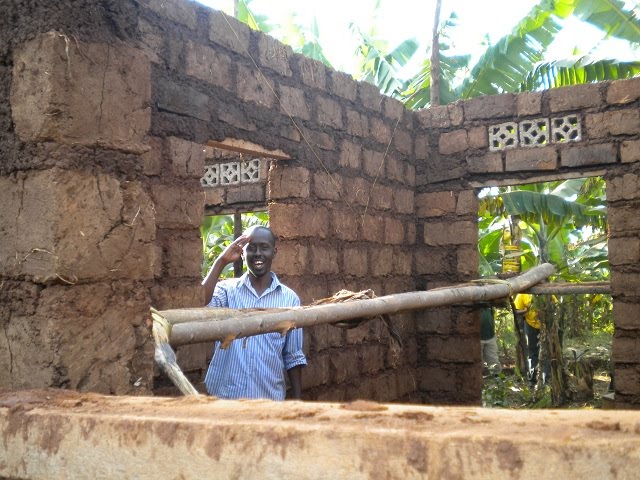
Building a new home: Day 4
Day 4: "
Jen Kamari checks in the with Waterloo MB Church Team:
I drove out to Kayonza again today to see the progress the team was making. My goodness! I couldn`t believe it. They have worked hard.
Another incredible sight... Veronic about floating around her property. I have NEVER seen her smile so much. Was a gift for me to see.
Next a roof, then some windows and doors, a cement floor and the outdoor kitchen.
Lots done but lots left to do.
"
Monday, July 12, 2010
If Anyone Takes Your Sunglasses, Let Them Have your Kit Kat Also
If Anyone Takes Your Sunglasses, Let Them Have your Kit Kat Also:
Su Roland writes ...
"While on a trip to Rome with our dear friends Gary, Joy, Joe and Jan, we were robbed by a band of gypsies while on a Metro train. We might have suspected what was going on, except that the group who crowded into our train car were young women carrying their babies. It seemed strange to have five young moms all get on at once and not talk to one another. Joe graciously offered his seat to one of them, but she ignored him and stood between the two of us. As we jostled through the moms and babies to get off at the next stop, Joe thought he felt a baby's foot pressed against his waistline. It was the mom's hand which successfully fetched cash and train tickets from his money belt and managed to unzip my own pack as well and grab my sunglasses. We realized what was happening before the train doors could close, but there was nothing we could do about it.
As the six of us gathered our wits and assessed the losses, we actually saw that very mom further up the platform! We ran after her and stopped her, asking for our things back. Since she was working in a pack of thieves, I'm sure she had already passed off our cash or glasses to another. She protested her innocence, but made no effort to escape. Joe and I ended up wasting over an hour in a hot, smoky, crowded Metro police office while the rest of our group waited outside the door.
We caught an insider's glimpse of how the Rome Metro police work (0r don't work!). At times we had up to eight officials in the room with us, doing absolutely nothing. One of them spoke English and told us we could not leave until the city police showed. We were literally prisoners in that stuffy, dark room! Meanwhile the gypsy mom continued to insist upon her innocence, vociferously protesting her detention and complaining of the heat.
After an hour or so I was feeling light-headed and asked permission to have Woody buy me a candy bar. Woody knocked at the door and handed me two Kit Kats, telling me to give the second one to the gypsy. I looked at him incredulously. 'Really? Give her one?' Woody gently encouraged me to do it.
At first she sullenly refused the Kit Kat. I kindly looked her in the eyes and insisted. The English-speaking officer told her in Italian, 'Go ahead. Take it! She wants you to have it.'
Thanks to Woody's encouragement, I began to change my perspective towards the gypsy mom. I began to pray for her. I knew that there was no chance we'd retrieve any of our lost possessions. The only way to redeem this lost time in Rome was to see the situation through God's eyes.
Shortly after eating her Kit Kat, she spoke to me through the translator. 'If I had the money, I'd give it back. I really would.' She even told me how many work in their band of thieves, though she still insisted she hadn't stolen from us herself.
When the Rome police finally showed up, they were not particularly friendly or helpful. The best thing they could do for us was to finally release us from that smoky, hot room which felt like our own prison cell by that point. They said they were escorting her out of the subway (where I'm pretty sure they just let her go!). Before leaving, though, I asked if I could share a few words with her through our translator. As a bevy of police stood around, I shared a few inadequate, but heartfelt words. 'God loves you and wants to forgive you. I believe you that you'd give back the money if you could. You need to turn to God to find forgiveness and to have the power to choose a different lifestyle. This is no way for you to live or raise your child. God wants you to turn to Him.'
I know that she is a woman hardened by life's circumstances, but I trust God spoke to her through my paltry words and Woody's prompting to be Christ to her in some small way. As for me, the loss of my sunglasses was worth the spiritual lessons I learned.
The next day I was reading from the book of Proverbs, and verse after verse struck me. Among them:
I doubt many people pray for that young gypsy woman. I'm sad that I did not ask her name. Her face, I will not forget. And, even as I write this blog, I am reminded to pray for her, that my inadequate words might be used in some small way to open her heart to the new life God would have for her.
"
Su Roland writes ...
"While on a trip to Rome with our dear friends Gary, Joy, Joe and Jan, we were robbed by a band of gypsies while on a Metro train. We might have suspected what was going on, except that the group who crowded into our train car were young women carrying their babies. It seemed strange to have five young moms all get on at once and not talk to one another. Joe graciously offered his seat to one of them, but she ignored him and stood between the two of us. As we jostled through the moms and babies to get off at the next stop, Joe thought he felt a baby's foot pressed against his waistline. It was the mom's hand which successfully fetched cash and train tickets from his money belt and managed to unzip my own pack as well and grab my sunglasses. We realized what was happening before the train doors could close, but there was nothing we could do about it.
As the six of us gathered our wits and assessed the losses, we actually saw that very mom further up the platform! We ran after her and stopped her, asking for our things back. Since she was working in a pack of thieves, I'm sure she had already passed off our cash or glasses to another. She protested her innocence, but made no effort to escape. Joe and I ended up wasting over an hour in a hot, smoky, crowded Metro police office while the rest of our group waited outside the door.
We caught an insider's glimpse of how the Rome Metro police work (0r don't work!). At times we had up to eight officials in the room with us, doing absolutely nothing. One of them spoke English and told us we could not leave until the city police showed. We were literally prisoners in that stuffy, dark room! Meanwhile the gypsy mom continued to insist upon her innocence, vociferously protesting her detention and complaining of the heat.
After an hour or so I was feeling light-headed and asked permission to have Woody buy me a candy bar. Woody knocked at the door and handed me two Kit Kats, telling me to give the second one to the gypsy. I looked at him incredulously. 'Really? Give her one?' Woody gently encouraged me to do it.
At first she sullenly refused the Kit Kat. I kindly looked her in the eyes and insisted. The English-speaking officer told her in Italian, 'Go ahead. Take it! She wants you to have it.'
Thanks to Woody's encouragement, I began to change my perspective towards the gypsy mom. I began to pray for her. I knew that there was no chance we'd retrieve any of our lost possessions. The only way to redeem this lost time in Rome was to see the situation through God's eyes.
Shortly after eating her Kit Kat, she spoke to me through the translator. 'If I had the money, I'd give it back. I really would.' She even told me how many work in their band of thieves, though she still insisted she hadn't stolen from us herself.
When the Rome police finally showed up, they were not particularly friendly or helpful. The best thing they could do for us was to finally release us from that smoky, hot room which felt like our own prison cell by that point. They said they were escorting her out of the subway (where I'm pretty sure they just let her go!). Before leaving, though, I asked if I could share a few words with her through our translator. As a bevy of police stood around, I shared a few inadequate, but heartfelt words. 'God loves you and wants to forgive you. I believe you that you'd give back the money if you could. You need to turn to God to find forgiveness and to have the power to choose a different lifestyle. This is no way for you to live or raise your child. God wants you to turn to Him.'
I know that she is a woman hardened by life's circumstances, but I trust God spoke to her through my paltry words and Woody's prompting to be Christ to her in some small way. As for me, the loss of my sunglasses was worth the spiritual lessons I learned.
The next day I was reading from the book of Proverbs, and verse after verse struck me. Among them:
- If your enemies are hungry, give them food to eat. If they are thirsty, give them water to drink. Proverbs 25:21
- Men do not despise a thief if he steals to satisfy himself when he is hungry. Proverbs 6:30
I doubt many people pray for that young gypsy woman. I'm sad that I did not ask her name. Her face, I will not forget. And, even as I write this blog, I am reminded to pray for her, that my inadequate words might be used in some small way to open her heart to the new life God would have for her.
Subscribe to:
Posts (Atom)